
China's Big Three Enter Agentic Commerce Race—The Redefinition of Super Apps Begins

Akihiro Suzuki
Twitter
Source: www.cnbc.com
Key Takeaways
- Alibaba, ByteDance, and Tencent are simultaneously implementing AI agent-powered automatic purchasing capabilities
- Market creation of up to $5 trillion is projected by 2030, driving fundamental transformation in e-commerce
- Global e-commerce businesses need to prepare for AI agent compatibility while monitoring China market trends
China's Big Three Launch AI Shopping Agents Simultaneously

Chinese tech giants race to create the 'everything app' of the future

China's tech giants are jostling to gain an edge in the AI race, as firms seek to develop models capable of coordinating and performing functions across sites.
In January 2026, China's three technology giants are making a full-scale entry into a new competitive arena called "agentic commerce." According to CNBC reporting, Alibaba, ByteDance, and Tencent are evolving their AI chatbots from "responsive AI" to "action-taking AI," building next-generation super apps capable of completing everything from shopping to payment.
The three companies are collectively investing approximately 300 million yuan (about $42 million) monthly in AI shopping tool development, seeking to fundamentally transform consumer e-commerce experiences.
Background and Industry Trends
Agentic commerce refers to a new purchasing paradigm where AI agents autonomously execute product searches, comparisons, negotiations, and purchases on behalf of consumers. Unlike traditional chatbots that simply "answer questions," agentic AI differs significantly by "taking actual action."
McKinsey & Company predicts that agentic commerce could generate $3-5 trillion in global sales by 2030. Morgan Stanley estimates the U.S. market alone could reach $190-385 billion, suggesting it may account for 10-20% of total e-commerce.
The background enabling Chinese companies to lead in this field is the deep penetration of super app culture. An environment where payments, logistics, and social networking are integrated into a single platform provides ideal conditions for AI agents to seamlessly traverse multiple services.
Detailed Initiatives by Each Company
Alibaba: Realizing "Action-Taking AI" with Qwen App
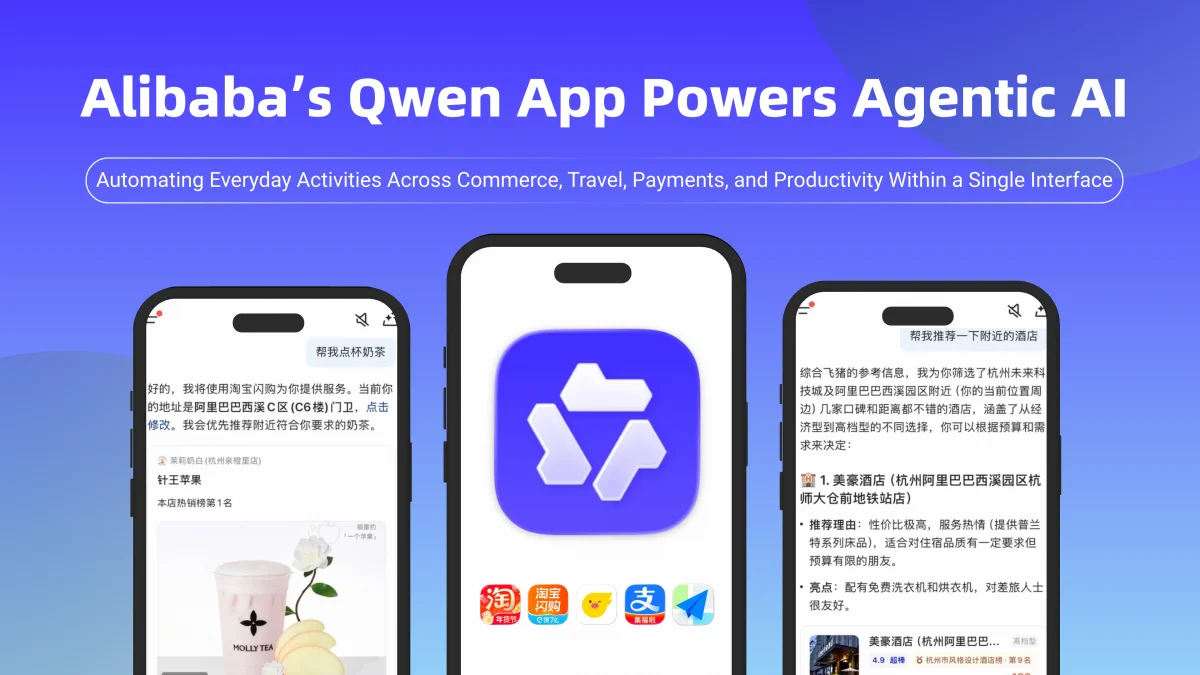
According to Alibaba's official announcement, the company implemented a major update to Qwen App on January 15, 2026. This update enables users to complete food ordering, travel booking, shopping, and payments entirely within the chatbot simply by giving voice or text instructions.
Specifically, Alibaba subsidiary services including Taobao (e-commerce platform), Alipay (payments), Fliggy (travel), and Amap (maps) have been integrated. PYMNTS.com reporting introduces a mechanism where payments through Alipay are completed within the conversational interface with just explicit user confirmation.
Wu Jia, Vice President of Alibaba Group, stated: "AI is evolving from intelligence to agency. What we're announcing today represents a transition from understanding models to action-taking systems." Qwen App surpassed 100 million monthly active users within two months of its November 2024 release, showing rapid adoption.
Furthermore, the "Task Assistant" feature (invite-only beta) can execute complex tasks such as automatic phone reservations at restaurants, itinerary planning including multiple locations, and simultaneous processing of up to 100 documents.
ByteDance: Achieving "30-Second Shopping" with Doubao
ByteDance upgraded its popular AI chatbot "Doubao" in December 2025, integrating it with Douyin's (Chinese TikTok) e-commerce functionality. Doubao is China's largest AI app with 157 million monthly active users.
When users input "recommend a humidifier for northern homes," five products in the 499-2,999 yuan price range are displayed within seconds, complete with detailed specifications and direct links to Douyin shops. The experience from product selection to payment completion takes about 30 seconds.
Supported categories span home appliances, mother and baby products, cosmetics, household goods, and more. Restaurant discounts and entertainment ticket recommendations through Douyin's group buying platform are also available. According to 36Kr, on smartphones co-developed with ZTE, Doubao functions as a comprehensive AI assistant, autonomously handling ticket reservations and other tasks.
ByteDance announced plans to invest 100 billion yuan (approximately $14.3 billion) in NVIDIA H200 AI chips in 2026, accelerating the strengthening of its AI infrastructure.
Tencent: Penetrating WeChat's 1.4 Billion Users with AI
According to South China Morning Post, Tencent has integrated its AI chatbot "Yuanbao" into WeChat. On WeChat, with over 1.4 billion monthly active users, users can add Yuanbao as a "friend" and use AI features without downloading a separate app.
Tencent President Martin Lau stated: "Within the Weixin (WeChat) ecosystem, there's an opportunity to build unique agentic AI," emphasizing that "the ability to access information, transactions, and operational functions across various vertical applications is extremely unique compared to other general-purpose agentic AI."
WeChat's strength lies in the integration of messaging, social networking (Moments), payments (WeChat Pay), and e-commerce (mini programs). Since food ordering, ride-hailing, and shopping can be completed without leaving the app through mini programs, AI agents can seamlessly execute transaction processing, purchase recommendations, and workflow optimization.
Impact and Implications for E-commerce Businesses
Short-term Impact (2026)
E-commerce businesses operating in the Chinese market need to consider compatibility with each platform's AI agents. Structuring product information (preparing product data in AI-friendly formats) becomes critical. Detailed specification information and use case descriptions are effective for enabling Alibaba Qwen App, ByteDance Doubao, and Tencent Yuanbao agents to appropriately recommend products.
Medium-term Outlook (2027 and Beyond)
Forrester's Charlie Dai points out: "AI agents will become the foundation for super app evolution. Success depends on deep integration of payments, logistics, and social engagement." Global e-commerce businesses should also consider AI agent compatibility premised on payment and logistics integration.
In the United States, OpenAI has partnered with Walmart to enable purchase completion within ChatGPT, and Google is also deploying AI agent-powered checkout functionality. Similar movements are highly likely to gain momentum in other markets over the next few years.
Considerations
Currently, each company's agentic capabilities are primarily for the Chinese domestic market. Cross-border e-commerce businesses need to continuously monitor each platform's support status. Additionally, since AI agents tend to recommend products based on "lowest price" or "highest rating" criteria, price competitiveness and customer review quality become more important.
Conclusion
The entry of China's three tech giants into agentic commerce holds the potential to fundamentally change e-commerce purchasing experiences. Now that the era of "entrusting shopping to AI" is becoming reality, e-commerce businesses are required to make three preparations.
First is AI-readiness of product data. Structured, detailed product information leads to appropriate recommendations by AI agents. Second is seamless integration of payments and logistics. An environment where AI agents can complete transactions becomes a competitive advantage. Third is continuous monitoring of China market trends. This market is serving as the world's testing ground for agentic commerce, and insights gained there can be expected to apply to other markets.
What to watch going forward is how far each company's agent capabilities can "act autonomously." A future where not just product recommendations, but price negotiations and return processing are automated is coming into view.
Related Articles
Alibaba Integrates Shopping into Qwen AI App: The Dawn of Agentic AI Era
Alibaba integrates Taobao, Alipay, and Fliggy into Qwen app, enabling end-to-end conversational commerce. Analysis of China's AI×EC market competition.
Microsoft Copilot Checkout Arrives: AI Commerce Market Now Has Four Major Players
Google, OpenAI, Microsoft, and Perplexity compete for AI commerce dominance with different protocols and revenue models. Here's what e-commerce businesses need to know about each player's strategy.

What is Agentic Commerce? Explaining the New Era of AI-Powered Purchasing
Explore the full scope of Agentic Commerce. AI agents autonomously execute everything from product selection to payment on behalf of users. Discover shocking data including 4,700% increase in AI-driven traffic and 20% of Walmart's traffic from ChatGPT, along with three essential preparation steps companies should start immediately.
Tags
Share this post