
What is Agentic Commerce? Explaining the New Era of AI-Powered Purchasing

Akihiro Suzuki
Twitter
Introduction
E-commerce and D2C businesses have achieved remarkable growth, propelled by technological advances such as the proliferation of the internet and the advent of smartphones. And now, with the practical application of generative AI, we stand at the threshold of yet another paradigm shift.
That shift is the future where "AI acts as a proxy for users in the purchasing process"—Agentic Commerce.
In this article, I will explain how this new concept is transforming current e-commerce, incorporating specific data and case studies. Rather than viewing this movement as merely a threat, I hope to help you see it as an "opportunity" for expanding new sales channels and assist you in formulating your future business strategies.
What is Agentic Commerce: A New Era Where AI Handles the Entire Purchasing Process
Agentic Commerce refers to "a new form of commerce where AI agents deeply understand user preferences, context, and past purchase history, then autonomously execute the entire purchasing process from product and service selection to ordering and payment."
Rather than explaining in words, it's best to see it in action. First, please watch this demonstration published by OpenAI.
Users simply express their needs in natural language, and AI finds optimal products and seamlessly completes everything from comparison to payment
Source: OpenAI Official
What this video depicts is a remarkably smooth purchasing experience:
-
Tell it what you want: Express your needs in natural language, such as "housewarming gift for a friend, handmade ceramic tableware, white and tan, under $100."
-
AI finds and suggests optimal products: The AI instantly understands your request and presents multiple products that match your criteria in image-based card format.
-
Select a product of interest and check details: Tap on a product from the suggestions and select specific options like "pasta bowl."
-
Complete payment immediately without leaving the chat: Pre-registered payment information is auto-filled, and checkout is completed with one tap without leaving the chat.
-
Receive purchase confirmation and delivery schedule: Order details, delivery date, and total payment amount are instantly displayed in the chat.
In this way, users simply express their needs in natural language, and AI finds optimal products and seamlessly completes everything from comparison to payment. This sequence shown in the video represents the fundamental vision of the world that Agentic Commerce aims to create.
Concrete Evolution: The Forefront of AI Shopping UX
To realize this future, implementation is accelerating across the industry. OpenAI has proposed the "Agentic Commerce Protocol (ACP)," an open common standard that establishes the technical foundation for smooth collaboration between AI agents and e-commerce businesses. Meanwhile, each platform is working on realizing Agentic Commerce through its own unique approach.
- Perplexity "Buy With Pro": Building a proprietary purchasing system, integrated with PayPal, enabling one-click purchase completion without leaving the chat screen. By citing multiple information sources and proposing products with highly reliable information, it powerfully supports users' purchase decision-making.

Perplexity suggests products while citing multiple sources, enabling one-click purchase completion
Source: Perplexity Official Blog
- Amazon "Rufus": Amazon, the world's largest e-commerce platform, has launched the AI chatbot "Rufus" specialized in its vast product catalog. Using its proprietary system to recommend optimal products from users' ambiguous questions and seamlessly integrating with existing Amazon checkout, it strengthens the Agentic Commerce experience within its own ecosystem.
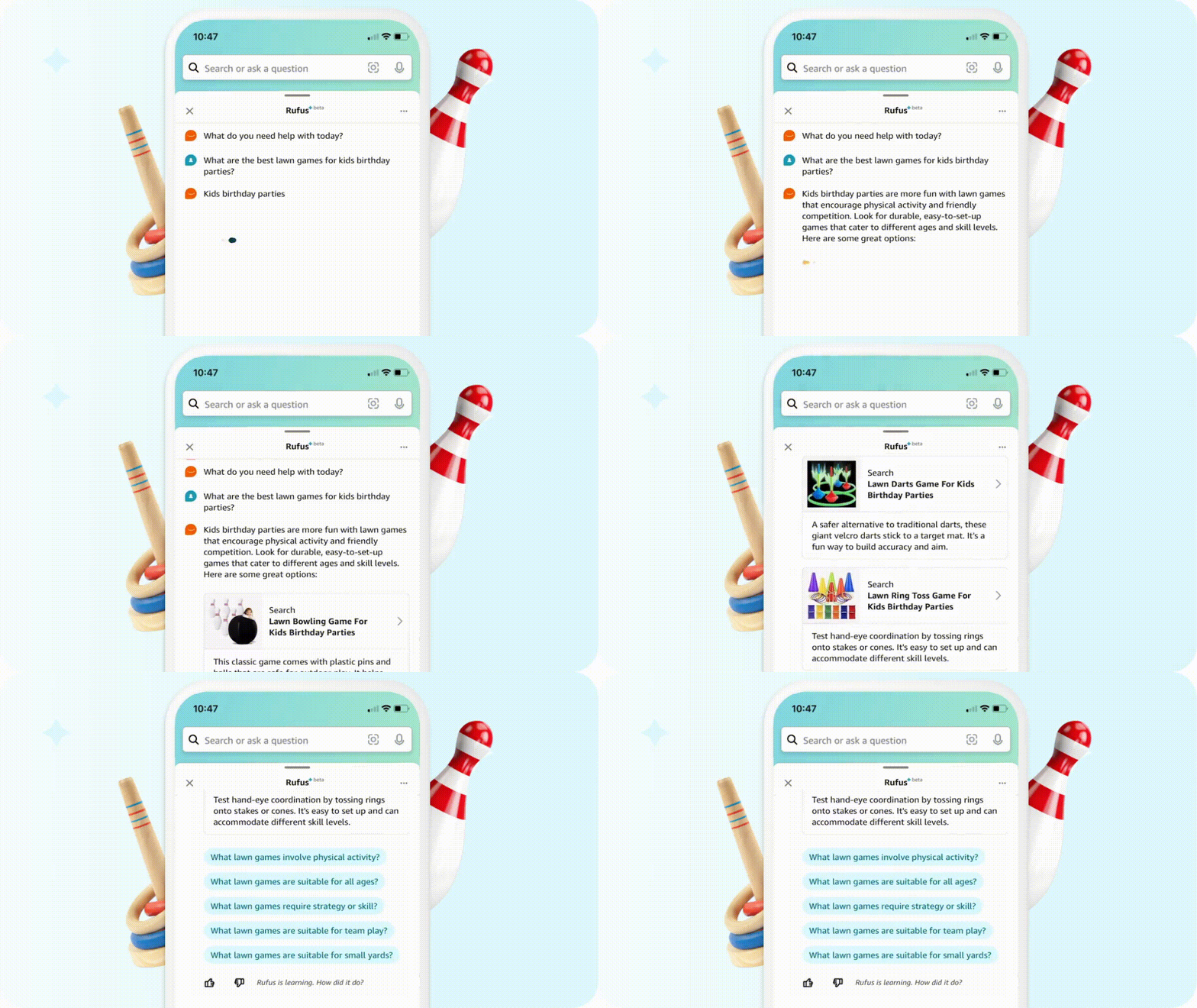
Amazon Rufus recommends optimal products from ambiguous questions and seamlessly integrates with existing checkout
Source: Amazon Official
- Google Shopping AI Enhancement: Google has developed a virtual try-on feature utilizing generative AI with its proprietary technology. When users select their body type and skin color, it generates images of models wearing the products accordingly. This aims to solve one of the biggest barriers in online shopping: "size mismatch."

Google's virtual try-on feature generates images of models wearing products based on body type and skin color
Source: Google Official Blog
These examples clearly suggest that AI is evolving from a mere search tool into a partner that engages in the entire purchasing process and enriches the customer experience itself.
Data-Driven Paradigm Shift: The Great Migration of Traffic from Search to AI
Agentic Commerce is not just a technology trend—it's a structural change that shakes the foundations of business. This conviction is backed by several shocking data points.
4,700% Increase in AI-Driven Traffic: Dramatic Changes in Consumer Behavior
The starting point of consumers' information gathering is dramatically shifting from traditional search engines to generative AI.
- According to Adobe Digital Insights (May 2024), generative AI-driven traffic to U.S. retail sites recorded an astounding 4,700% year-over-year increase.
- Another analysis (Previsible, June 2024) also reported that AI-driven session numbers from January to May 2024 reached +527% compared to the same period the previous year.
- Bain & Company's research shows that shopping-related queries on ChatGPT doubled in just six months, accounting for about 10% of all searches. This means approximately 50 million purchase-intent conversations occur daily.
- This traffic is also high quality; according to Boston Consulting Group, AI-driven users show 10% higher engagement and 27% lower bounce rates.
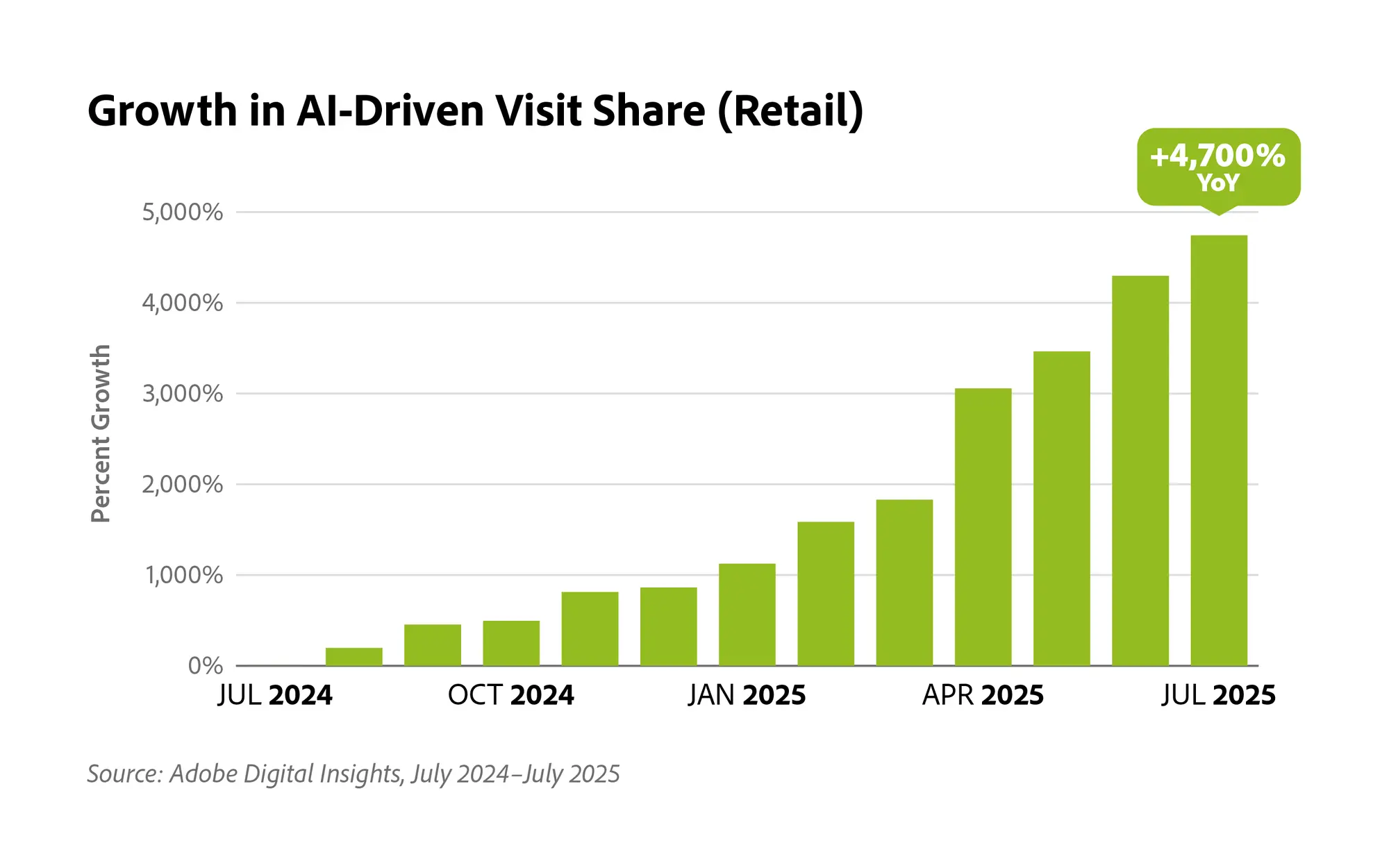
AI-driven traffic continues rapid growth with a 4,700% year-over-year increase
Source: Adobe Digital Insights
20% of Walmart Traffic from ChatGPT: The Rise of a New Channel
This shift is beginning to reshape the power dynamics of existing customer acquisition channels.
- Similarweb data (2024) shows that 20% of referral traffic to Walmart comes from ChatGPT, with Etsy at over 20% and Target at about 15%, demonstrating that the "AI channel" already has a massive presence.
- Meanwhile, traditional SEO faces a major crossroads. When Google's AI Overviews are displayed, organic search click-through rates drop by 34.5% according to research (SurferSEO). In fact, some media sites have reported traffic decreases of up to 70%, and Gartner predicts that traditional search traffic will decrease by 25% by 2026.
From SEO to GEO: 90% of B2B Buyers Utilize AI
To respond to this environmental change, companies need to shift their strategic focus from "SEO (Search Engine Optimization)" to "GEO (Generative Engine Optimization)." GEO is an initiative to optimize content and data so that your company's products and services are cited and recommended in AI responses. Walker Sands research shows that 90% of B2B buyers already use generative AI in their purchasing process, making GEO no longer an option but a necessary survival strategy.
Physical World Agentification: An Era Where Everything Autonomously "Buys"
Agentic Commerce is predicted to permeate all aspects of our lives, not just remain within specific chat screens. After chat UI purchasing becomes widespread, integration with voice assistants will follow, and eventually, the environment surrounding users will function as purchasing agents.
- Voice Assistant Purchasing: Amazon's Alexa is connected to over 300 million devices worldwide, with users giving shopping instructions hundreds of millions of times weekly. Data shows that about 27% of smart speaker owners shop by voice at least once a month, and the world of "speak and buy" is already becoming reality.
- Smart Home and Environmental Automatic Purchasing: Smart refrigerators monitor internal inventory and automatically order when milk runs low. Washing machines detect detergent levels and order refills. Such Ambient Intelligence taking over shopping is no longer far off. This Ambient computing market is growing at around 25% annually and is expected to reach approximately $96 billion by 2030.
- Connected Cars: Cars will also become agents. They will detect when oil changes are due and book appointments with dealers, or determine optimal refueling timing based on fuel levels—an era where cars spend money for their own maintenance.
- Embodied / Ambient / Context-aware Agents: These are keywords indicating the fusion of the physical world and digital agents. The purchasing style of "Ambient Commerce," where "users get what they need before they're even aware of purchasing," is predicted to reach a market size of $1.7 trillion by 2030. This represents a massive impact equivalent to the current global e-commerce market.

A future where the environment itself functions as a purchasing agent, including smart homes and connected cars
In such a world, the interaction of humans "pressing the purchase button" itself may gradually become a thing of the past. For companies, rather than the previously standard UI/UX strategy of "how to attractively display products on screens," "how to get AI agents to select your products"—a strategy for AI as the new decision-maker—becomes important.
Three Preparations Companies Should Start Immediately
To respond to this major change, companies need to start preparing now. For the Agentic Commerce era, I recommend starting with the following three steps.
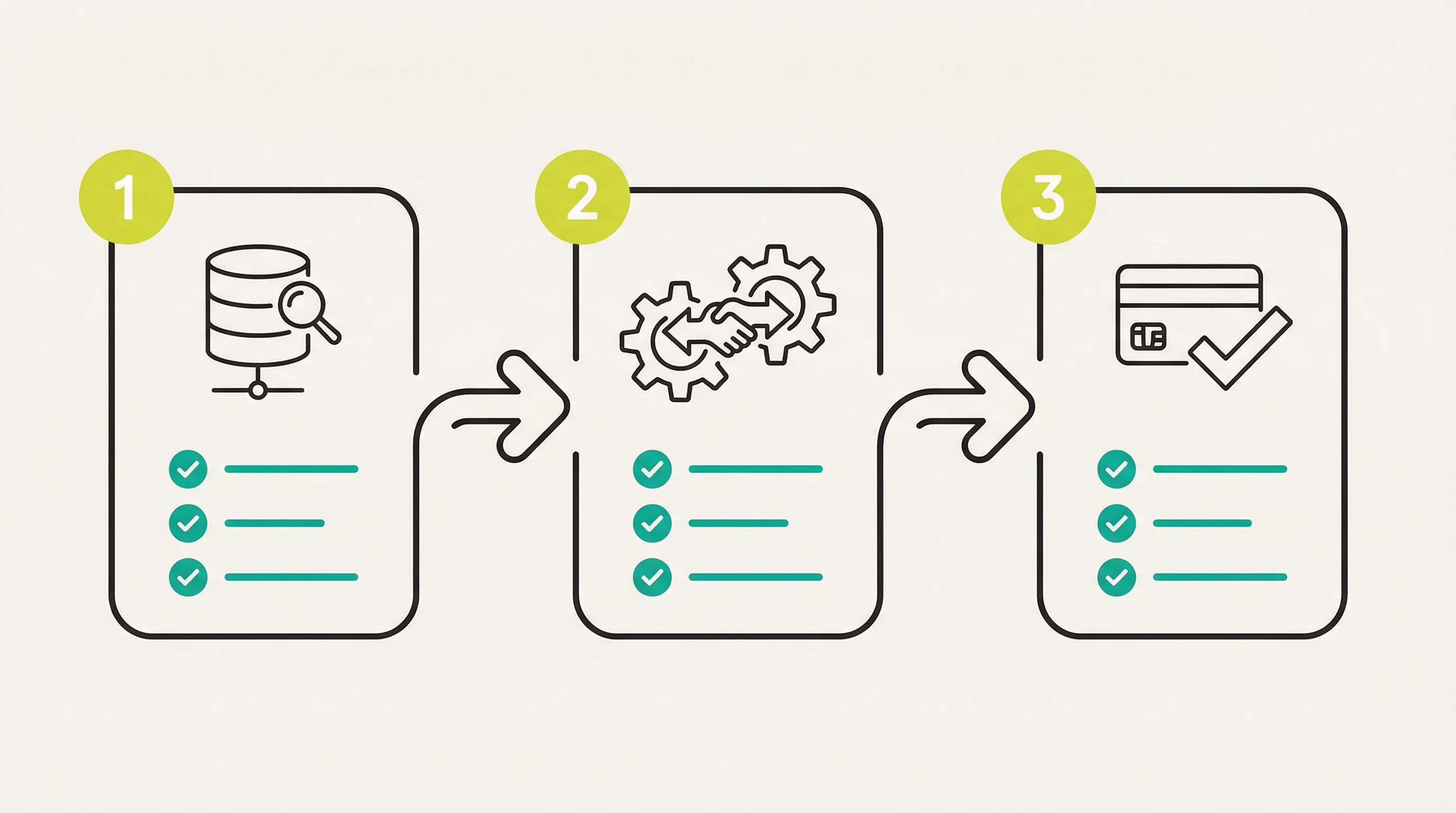
Prepare for Agentic Commerce with three steps: data structuring, API integration, and ACP protocol compliance
Step 1: Structuring Product Data for AI Understanding
For AI agents to accurately understand products and make appropriate recommendations, it's essential that product data is organized in machine-readable format.
Specific Actions:- Organize basic information such as product names, descriptions, specifications, prices, and inventory status as structured data
- Implement markup compliant with standards like Schema.org
- Clarify product category hierarchical structure
- Properly assign alt attributes and metadata to image data
At many companies, product data is unstructured or managed separately across different systems. Integrating these and organizing them into AI-friendly formats is the first step in Agentic Commerce readiness.
Step 2: Real-time API Integration for Inventory and Delivery Information
In Agentic Commerce, AI checks inventory status and delivery availability in real-time and presents optimal options to users. Therefore, a system capable of providing this information at high speed via API is required.
Specific Actions:- API integration of inventory management systems (real-time inventory inquiry)
- Dynamic calculation API for delivery options and shipping costs
- Order processing API setup (with ACP protocol compliance in mind)
- API response speed optimization (ideally under 100ms)
In traditional e-commerce, out-of-stock situations might be discovered after users add items to cart, but in Agentic Commerce, accurate inventory information is needed at the AI proposal stage.
Step 3: ACP Protocol Compliance for Major AI Platforms
The Agentic Commerce Protocol (ACP) proposed by OpenAI and Stripe is a standard specification connecting AI agents and e-commerce businesses. By preparing for compliance with this specification, you can secure sales opportunities on major AI platforms including ChatGPT.
Specific Actions:- Understand ACP technical specifications and verify compatibility with your systems
- Build collaboration framework with payment providers (Stripe, etc.)
- Verify and address security requirements (authentication, encryption, etc.)
- Operational verification in test environments
While ACP is still an evolving specification, early compliance may provide first-mover advantages in AI channels.
These preparations cannot be completed overnight. However, by working on them step by step starting now, you can prepare for the arrival of the Agentic Commerce era. In particular, data organization is the foundation of everything and should be the highest priority area.
Our Initiative: Agentic Commerce Implementation Support
Amid this major trend, we at Stellagent Inc. support mid-sized and emerging companies in adapting to this new era as "implementers" of Agentic Commerce.
Main Support Services:- Building agent EC stores on ChatGPT and Perplexity
- Technical support for ACP protocol compliance
- Product data structuring and API integration consulting
- AI channel utilization strategy planning and execution support
What we aim for is the realization of a fairer competitive environment where you can compete based on product appeal and fit, without depending on advertising costs. We want to create a future together where your products are appropriately suggested the moment purchase intent arises among users on AI platforms used by 700 million people.
Conclusion: Embracing Change as Opportunity and Creating the Future Together
The 4,700% increase in AI-driven traffic, 34.5% decline in search click-through rates, and predictions of 25% decrease in search traffic by 2026—these are not fantasies but realities happening right before our eyes.
"The next search, next e-commerce, and next advertising will converge into AI agent-driven purchasing"—I am convinced of this. Because we are in the dawn phase, there is an opportunity to guide this future in a better direction.
The future where AI handles part of the purchasing process is not a distant story but a reality spreading in real-time. This is not something that threatens existing businesses, but rather a new chance to "deliver your products' appeal to more customers with needs through AI."
What's important is to embrace the coming change positively and start preparing, even gradually. Why not begin by asking, "Is our product data in a state that's easy for AI to read?" and consider new strategies from there?
We aspire to be the best partner for companies taking that first step.
Related Articles

What is Apps in ChatGPT? Complete Guide to Features and Use Cases
Learn about Apps in ChatGPT, the new feature that lets you use third-party apps directly within conversations. Discover how Instacart and DoorDash enable shopping from chat to checkout, and explore the future of conversational commerce.

What is Agentic Payment? AI-Powered Next-Gen Automated Payments
[2-Minute Read] Learn about Agentic Payment, where AI agents autonomously handle payments. Discover the mechanisms, key players like Visa, Mastercard, and Stripe, and implementation strategies for automated payment systems.

What is Instant Checkout? Revolutionary Feature for In-Chat Purchase Completion
[2-Minute Read] Learn about Instant Checkout mechanisms and benefits. Discover how completing product discovery to purchase within AI chat reduces abandonment and boosts conversion in Agentic Commerce implementation.
Tags
Share this post