Klarna Joins Google's UCP — Payment Giant's Entry Accelerates the "Common Language" of Agentic Commerce

Akihiro Suzuki
Twitter
Source: thefintechtimes.com
Key Takeaways
- BNPL giant Klarna announced joining Google's Universal Commerce Protocol (UCP) on February 2
- UCP is an open standard co-developed by 5 companies including Shopify and Walmart, endorsed by 20+ companies
- Klarna's participation enables BNPL payments to be available through AI agents
Payment Giant Klarna Joins Agentic Commerce Standardization
Klarna Backs Google's Universal Commerce Protocol to Power the Future of 'Agentic' Shopping

Klarna has joined Google's Universal Commerce Protocol, an open standard designed to enable AI agents to handle end-to-end shopping—from discovery to payment—across the $1trillion agentic commerce market.
On February 2, 2026, Swedish fintech giant Klarna officially announced its participation in Google's Universal Commerce Protocol (UCP). UCP is an open standard that enables AI agents to handle everything from product discovery to payment and post-purchase support in a unified flow. With Klarna's participation, BNPL (buy now, pay later) payments backed by 114 million active users are now integrated into the agentic commerce standard infrastructure.
Klarna's Chief Commercial Officer David Sykes stated, "As AI-driven shopping continues to evolve, it's critical that the commerce infrastructure underpinning it is built on openness, trust, and transparency."
Background and Industry Trends
Competition over protocol standardization for agentic commerce has accelerated rapidly in 2026. Google announced UCP at the NRF (National Retail Federation) conference on January 11. Co-developed with Shopify, Walmart, Target, Wayfair, and Etsy, over 20 companies including Adyen, American Express, Best Buy, Mastercard, Stripe, The Home Depot, Visa, and Zalando have signed on as endorsers.
Meanwhile, OpenAI and Stripe announced the Agentic Commerce Protocol (ACP) first in September 2025, putting it into practice with ChatGPT's Instant Checkout feature. Microsoft also launched Copilot Checkout in January 2026. The three major AI platforms have each established their own purchasing channels.
The scale of this market is noteworthy. McKinsey predicts agentic commerce could grow to $3-5 trillion globally by 2030. Morgan Stanley estimates $190-385 billion in the U.S. alone, and Bain & Company projects agentic commerce will account for 15-25% of U.S. e-commerce sales.
Strategic Significance of Klarna's Participation
Klarna's move goes beyond mere protocol participation. It carries three strategic implications.
Deepening Multi-Layered Partnership with GoogleKlarna began supporting Google's Agent Payments Protocol (AP2) in October 2025 and has built a multi-year partnership spanning Google Pay, Google Store, Google Play, and Google Cloud infrastructure. Joining UCP deepens this relationship further. Ashish Gupta, VP and GM of Google Merchant Shopping, commented, "Open standards like UCP are essential to bringing AI-powered commerce to scale. Klarna's endorsement is a great example of cross-industry collaboration that expands choice while maintaining security."
New Territory: Agent-Ready BNPL PaymentsWith Klarna's participation, AI agents can seamlessly present BNPL (buy now, pay later) options during the shopping process. Klarna's real-time credit decision engine, which processes 3.4 million transactions daily, becomes directly available within AI-driven conversations. This significantly expands UCP's payment options, which previously centered on credit cards and Google Pay.
Payment Providers' "Both Sides" StrategyNotably, Stripe is both a co-developer of ACP and an endorser of UCP. As Checkout.com's analysis points out, payment providers are taking a "both sides strategy," supporting multiple standards rather than betting on a specific protocol. Klarna, while participating in Google's UCP and AP2, may also be considering ACP support in the future.
Competition and Complementarity Between UCP and ACP
For e-commerce businesses, it's important to correctly understand the relationship between UCP and ACP.
UCP is a comprehensive protocol covering the full journey from product discovery to cart building, checkout, loyalty integration, and post-purchase support. It's transport-agnostic, supporting integration via REST API, Agent2Agent (A2A), and MCP, with businesses able to dynamically publish their capabilities at the /.well-known/ucp endpoint.
ACP, on the other hand, is a checkout-focused protocol tightly integrated with Stripe's payment infrastructure. Its strength is convenience—businesses already using Stripe can enable ChatGPT Instant Checkout with as little as one line of code.
Industry consensus is converging on "adopt both." UCP covers the upper funnel (product discovery and comparison), while ACP covers the lower funnel (instant in-chat purchases), complementing each other to maximize merchant reach. Walmart is actually taking a dual approach, using both OpenAI partnerships (ChatGPT sales via ACP) and Google's UCP.
Impact and Actions for E-Commerce Businesses
Following Klarna's participation, there are three key actions e-commerce businesses should consider.
Prepare for Expanded Payment OptionsWith a major BNPL player joining UCP, diverse payment methods become available in AI agent-mediated shopping experiences. Businesses need to verify whether their payment infrastructure can handle an environment where Google Pay, PayPal, and Klarna's installment payments are all options. Shopify merchants can adapt relatively smoothly since the platform co-developed UCP, but custom e-commerce platforms will need individual implementation plans.
Develop a Multi-Protocol StrategyA strategy supporting multiple protocols—not just UCP, ACP, or Microsoft Copilot Checkout—is necessary. ChatGPT has 700-900 million weekly active users, while Google Search and Gemini process billions of search queries daily. Supporting only one means significant lost sales opportunities.
Optimize Product Information to Be "Chosen by AI Agents"In agentic commerce, AI agents perform product comparison and recommendations. AEO (Agentic Engine Optimization) efforts—structured data registration with Google Merchant Center, clear product descriptions, real-time inventory and shipping updates—will determine future competitiveness. Payment option availability, such as Klarna, may also influence agent recommendation decisions.
Summary
Klarna's UCP participation is evidence that agentic commerce standardization is expanding from "tech company-led" to "the entire ecosystem including payment and fintech companies." With Klarna, a NYSE-listed company (KLAR), bringing its 114 million user base and BNPL market brand power to UCP, the range of shopping experiences AI agents can offer will definitely expand.
UCP's roadmap includes international expansion to India and Brazil and post-purchase support integration in the latter half of 2026. E-commerce businesses should prepare with an eye toward eventual impact on the Japanese market. As PYMNTS CEO Karen Webster points out, "Agent-led commerce is not a revolution, but the next logical step." The infrastructure for that "next step" is being built right now.
Related Articles
Google Announces Universal Commerce Protocol (UCP), Forms Major Coalition for Agentic Commerce Standardization
Google unveiled UCP at NRF 2026, an open standard co-developed with Shopify, Walmart, and 20+ partners to standardize AI agent-powered shopping experiences.
Understanding UCP Technical Specifications: How AI Agents Purchase Products
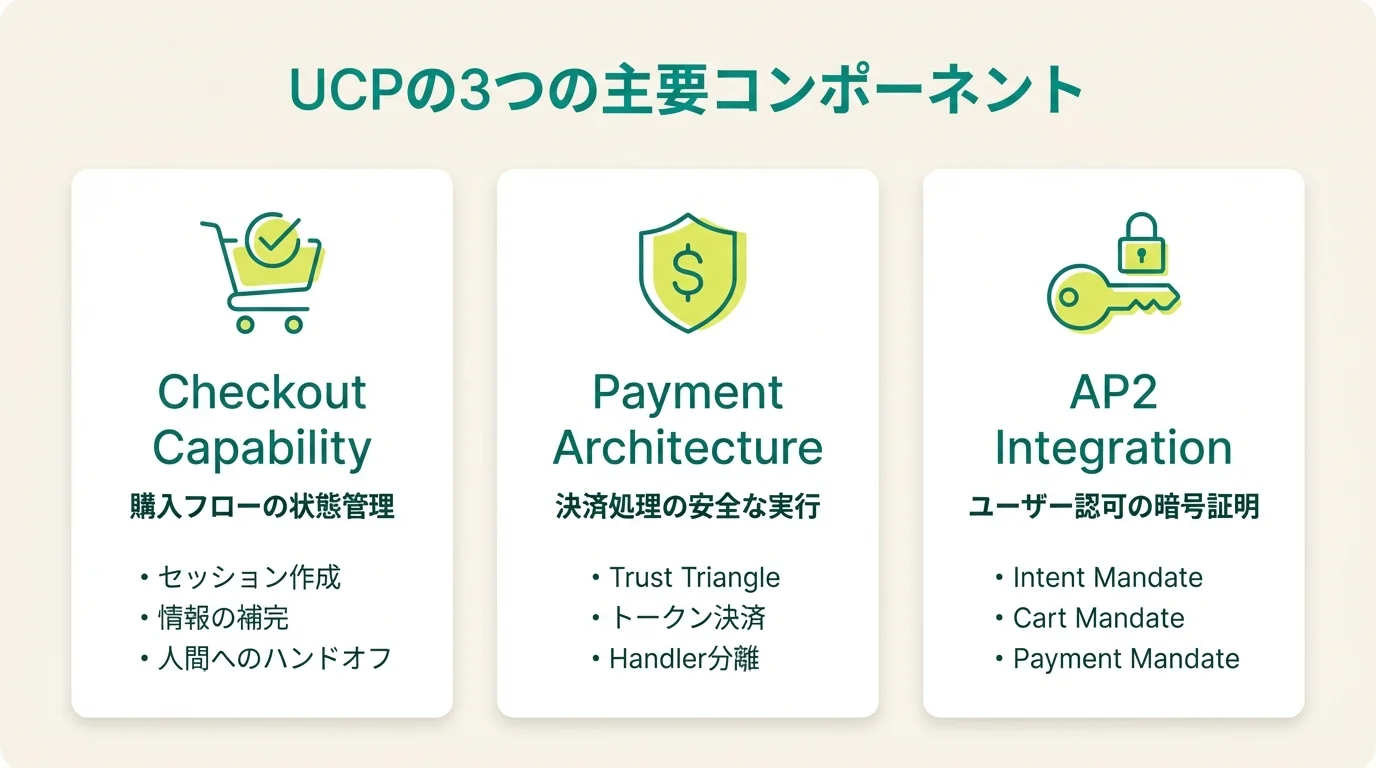
A deep dive into the technical architecture of Google's Universal Commerce Protocol (UCP). Learn about checkout state transitions, the Trust Triangle payment model, and AP2 mandates for conditional automatic purchases.
MCP, A2A, UCP — Making Sense of the Proliferating Agentic AI Protocols
The Register systematically categorizes and explains major agentic AI protocols including MCP, A2A, and UCP. Standardization gains momentum with the Linux Foundation's AAIF establishment
Tags
Share this post