
eMarketer Predicts AI Commerce Market to Reach $144 Billion by 2029

Akihiro Suzuki
Twitter
Source: www.emarketer.com
Key Takeaways
- eMarketer releases AI Commerce 2026 report predicting e-commerce sales through AI platforms will reach $144 billion by 2029
- AI commerce is set to account for 8.8% of total e-commerce sales, potentially disrupting Amazon's market dominance
- E-commerce businesses urgently need to address AI search optimization (AEO) and consider implementing proprietary AI assistants
AI Platforms Emerge as New E-commerce Sales Channel
AI Commerce 2026

Growing consumer adoption of AI tools is positioning AI platforms as an alternative shopping channel—but most AI-driven transactions are still completed on retailer websites.
U.S. research firm eMarketer released its "AI Commerce 2026" report in January 2026. According to the report, e-commerce sales through AI platforms such as ChatGPT, Google, and Perplexity are projected to reach $144 billion by 2029. This represents 8.8% of total e-commerce sales.
The AI commerce market is projected to be $20.9 billion in 2026, representing approximately 4x growth from 2025. The "era of AI commerce" where consumers use AI tools to discover, research, and purchase products is about to begin in earnest.
Major Players Launch AI Shopping Features in Succession
The rapid growth of the AI commerce market is being driven by aggressive feature rollouts from major players. According to Modern Retail, Perplexity announced an AI shopping agent for U.S. users in November 2024, providing functionality to complete everything from product research to purchase within the app.
OpenAI also announced partnerships with Target, Instacart, and DoorDash, enabling direct purchases within ChatGPT. Furthermore, Amazon released an agent feature called "Buy For Me," creating a mechanism to purchase products from other sites within the Amazon app.
Consumer Behavior Changes Are Striking
Consumer adoption of AI shopping is also expanding rapidly. According to eMarketer's research, 53% of U.S. consumers who searched with generative AI in Q2 2025 also used generative AI for shopping purposes. Shopping-related generative AI searches recorded a staggering 4,700% growth from 2024 to 2025.
Additionally, 41% of consumers say they trust generative AI search results more than traditional advertising, and 85% show high satisfaction with AI-assisted shopping experiences.
Emerging Forces Challenging Amazon's Market Dominance
eMarketer points out in its "Retail Trends to Watch in 2026" report that AI commerce will be one of the factors shaking Amazon's marketplace dominance. As consumers discover and purchase products through ChatGPT and Perplexity, purchasing behavior that bypasses traditional Amazon search will increase.
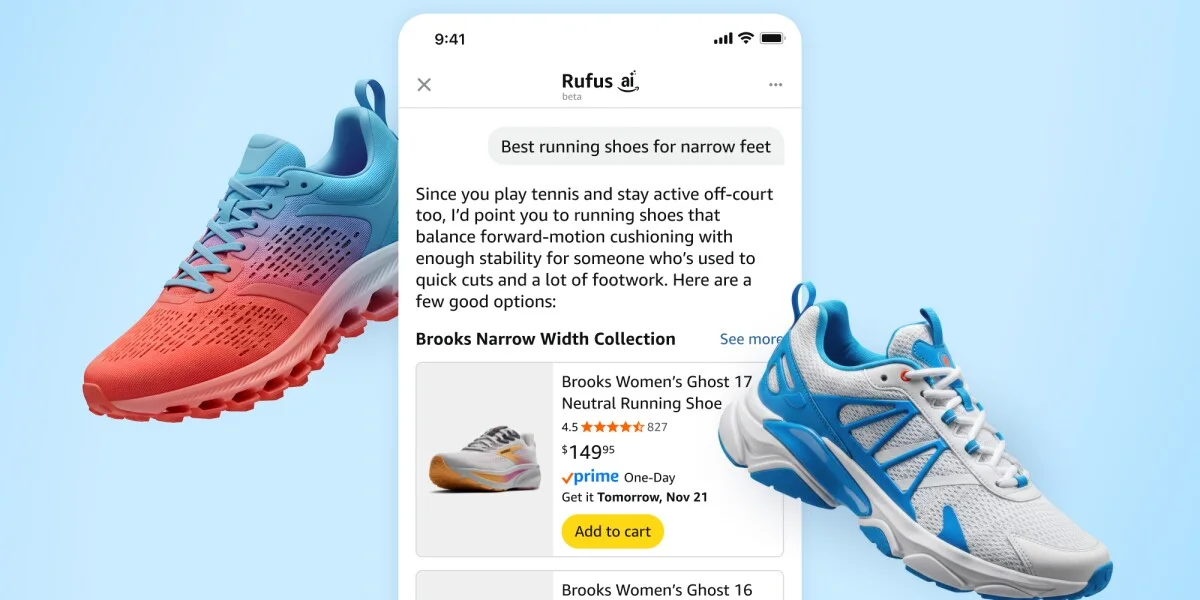
However, Amazon is also taking countermeasures. The company's AI shopping assistant "Rufus" has added an "Auto Buy" feature that automatically purchases when a specified price is reached. Amazon has also made clear its stance on blocking access from external AI agents, suing Perplexity and taking other actions to protect its $56 billion advertising business.
Walmart and Amazon Take Divergent AI Strategies
According to eMarketer's analysis, the AI strategies of the two major retailers are contrasting. Walmart has adopted an "available everywhere" approach through its partnership with Google Gemini, deploying the AI assistant "Sparky" both inside and outside the app. Amazon, on the other hand, has chosen a strategy of confining AI agents within its own ecosystem.
Other Research Firms Also Predict Market Growth
Gartner predicts that by 2028, 90% of B2B transactions will be conducted through AI agents, with a scale exceeding $15 trillion. Forrester expects that a quarter of shoppers will use AI chatbots in 2026.
Impact on E-commerce Businesses and Applications
AEO (Answer Engine Optimization) Becomes Essential
As AI platforms emerge as purchasing channels, e-commerce businesses need new optimization strategies. In addition to traditional SEO, preparing structured data that AI can easily read and "AEO (Answer Engine Optimization)" for AI search engines becomes important.
Specifically, it is recommended to structure product information with schema markup so that AI can accurately understand product attributes. Enriching FAQ-format content also has the effect of making information more likely to be cited by AI assistants.
Consider Implementing Proprietary AI Assistants
Forrester recommends that savvy retailers should invest in proprietary AI shopping assistants that guide customers through the entire purchasing journey. Significant cost reductions can be expected through personalized recommendations and streamlined post-purchase communication.
Challenges: Privacy and Reliability
However, according to Omnisend's survey, only 34% of consumers are willing to let AI assistants make purchases on their behalf. Additionally, Amazon CEO Andy Jassy points out that many AI shopping agents have issues with accuracy of pricing and delivery estimates. Ensuring accuracy and transparency is essential to earning consumer trust.
Summary
eMarketer's AI Commerce 2026 report predicts the arrival of an AI commerce market that will grow to $144 billion by 2029. AI platforms such as ChatGPT, Perplexity, and Google Gemini are establishing themselves as new purchasing channels, potentially bringing changes to the traditional marketplace-centric market structure.
For e-commerce businesses, 2026 will be a turning point for AI commerce readiness. By preparing now—structuring product data, implementing AEO measures, and considering proprietary AI assistants—businesses can build competitive advantages in the AI commerce era.
Related Articles
Amazon Rufus: The Full Picture of the AI Shopping Assistant Used by 250 Million People
Amazon Rufus reaches 250 million users and drives $10 billion in additional sales. Deep dive into its technology, features, and implications for e-commerce.

Walmart and Google Announce Agentic AI Partnership: A New Era for Retail Begins
At NRF 2026, Walmart and Google announced a new shopping experience through Gemini AI. Universal Commerce Protocol (UCP) enables personalized recommendations based on purchase history.

The AI Commerce Three-Way Battle: Google, Amazon, and OpenAI Clash Over the Next-Gen E-Commerce Market
Google, Amazon, and OpenAI are competing with different approaches in the AI commerce market. McKinsey predicts a $3-5 trillion market opportunity by 2030. E-commerce businesses need to prepare for multi-protocol support.
Tags
Share this post