
Amazon CEO Announces AI Shopping Strategy at Davos, $10 Billion OpenAI Investment Negotiations Underway

Akihiro Suzuki
Twitter
Source: www.modernretail.co
Key Takeaways
- Amazon CEO Andy Jassy unveiled his vision for AI-driven shopping transformation at Davos
- Negotiations for over $10 billion investment in OpenAI are ongoing, with Trainium chip adoption also in play
- The AI shopping agent market is expected to grow to $1 trillion, making e-commerce adaptation urgent
Amazon CEO Discusses the Future of AI Commerce

Amazon CEO expects to partner with third-party AI shopping agents

Amazon expects to eventually partner with third-party AI shopping agents, even as the e-commerce giant continues to block shopping agents from scraping its site.
On January 20, 2026, at the World Economic Forum (WEF) in Davos, Switzerland, Amazon CEO Andy Jassy revealed his detailed vision for the future of AI and shopping. In an interview with CNBC's Becky Quick, he also commented on consumer trends, stating "consumers are quite resilient and continue to shop. They're trying to keep prices down as much as possible and looking for good deals."
Jassy also emphasized AI's potential to recreate online the "serendipity" or chance discoveries that make in-store shopping appealing. This suggests AI could become a new means for e-commerce operators to create novel customer experiences.
Background and Industry Trends
Competition around AI shopping agents has intensified rapidly since late 2025. According to CNBC reporting, Amazon faces a dilemma: "fight AI shopping agents or join them."
Market size continues to expand. Consulting firm McKinsey predicts that Agentic Commerce has "$1 trillion revenue potential" in the US alone. Morgan Stanley analysts noted in their November 2025 report that "agentic commerce, having a personal digital interactive shopper, will be the next big GenAI unlock."
Currently, about 40-50% of consumers use AI for product research, and traffic from AI assistants increased 119% year-over-year in the first half of 2025. This trend is impossible for e-commerce operators to ignore.
The Truth Behind the $10 Billion OpenAI Investment Negotiations
Alongside Jassy's Davos statements, attention is focused on Amazon's negotiations to invest over $10 billion in OpenAI. According to WebProNews, if this deal closes, OpenAI's valuation could exceed $500 billion.
A distinctive feature of this investment is that it's packaged with "Trainium chip adoption." Amazon is asking OpenAI to expand server rentals on AWS and adopt its in-house AI semiconductor "Trainium." OpenAI has already contracted $38 billion worth of servers from AWS over seven years, with this $10 billion potentially adding to that arrangement.
However, as TechCrunch points out, this deal has characteristics of "circular financing." The structure where Amazon's invested funds return as AWS usage fees has raised concerns among investors. Note that Microsoft holds exclusive marketing rights for OpenAI's most advanced models through the 2030s, so Amazon cannot market these models.
Jassy himself evaluated OpenAI's $1 trillion infrastructure plan as "ambitious and forward-thinking" while showing caution, saying "it's difficult to understand everything."
The Frontlines of AI Shopping Agent Competition
Each company's AI shopping strategy is clearly differentiated.
Amazon is strengthening lock-in within its own platform. According to Amazon's official announcement, the AI assistant "Rufus" underwent over 50 technical upgrades in 2025. Monthly active users grew 149% year-over-year, interactions increased 210%, with over 250 million users.
Notable is the "Buy For Me" feature. When searching for products not carried by Amazon, Amazon purchases from third-party sites on your behalf. Fortune reports that Rufus is expected to generate $10 billion in additional annual sales.
OpenAI introduced "Instant Checkout" functionality to ChatGPT in September 2025. According to TechCrunch, they've partnered with Walmart, Shopify, Target, Etsy, plus Instacart and DoorDash to enable direct purchases within ChatGPT. They've also released the "Agentic Commerce Protocol (ACP)" co-developed with Stripe as open source, aiming to expand the ecosystem.
Microsoft announced "Copilot Checkout" in January 2026. According to GeekWire, purchases can be completed within the AI chatbot without redirecting to external sites. They also announced "Brand Agents" for Shopify, differentiating through existing enterprise relationships.
Google has also announced its own payment protocol "Agent Payments Protocol (AP2)," clearly competing with OpenAI.
Impact and Applications for E-commerce Operators
According to Modern Retail's analysis, if 2025 was the year for building agentic commerce foundations, 2026 will determine whose AI agent becomes the default shopping interface. Here's what e-commerce operators should address immediately:
"AI agent compatibility" has become mandatory. Given that Amazon blocks external AI bots (OpenAI, Anthropic, Meta, Google, Huawei) while strengthening its own Rufus, strategic decisions are needed on which platform's AI agents to optimize for.
"Product data structuring" is also crucial. Product information must be organized so AI agents can accurately understand and recommend products. Vague descriptions or incomplete metadata lead to disadvantages in AI search.
"Multi-channel strategy" review is necessary. Consider supporting open protocols like OpenAI's ACP and Google's AP2. Diversifying platform dependency risk becomes important.
Summary
Andy Jassy's Davos statements clearly demonstrated Amazon's intent to lead AI commerce. The $10 billion OpenAI investment negotiations serve as both a counter to competing Microsoft-OpenAI partnership and a strategic investment with the practical benefit of expanding Trainium chip distribution.
The evolution of customer experience through Rufus, the "borderless marketplace" via Buy For Me, and blocking external AI agents represents a dual "offense and defense" strategy that significantly impacts the entire e-commerce industry.
What matters for e-commerce operators is reconstructing strategy with the AI shopping agent era as a given. If Jassy's vision of "AI recreating the serendipity of physical stores" is realized, customer touchpoints will fundamentally change. In 2026, whether you can ride this transformation wave will determine e-commerce success or failure.
Related Articles
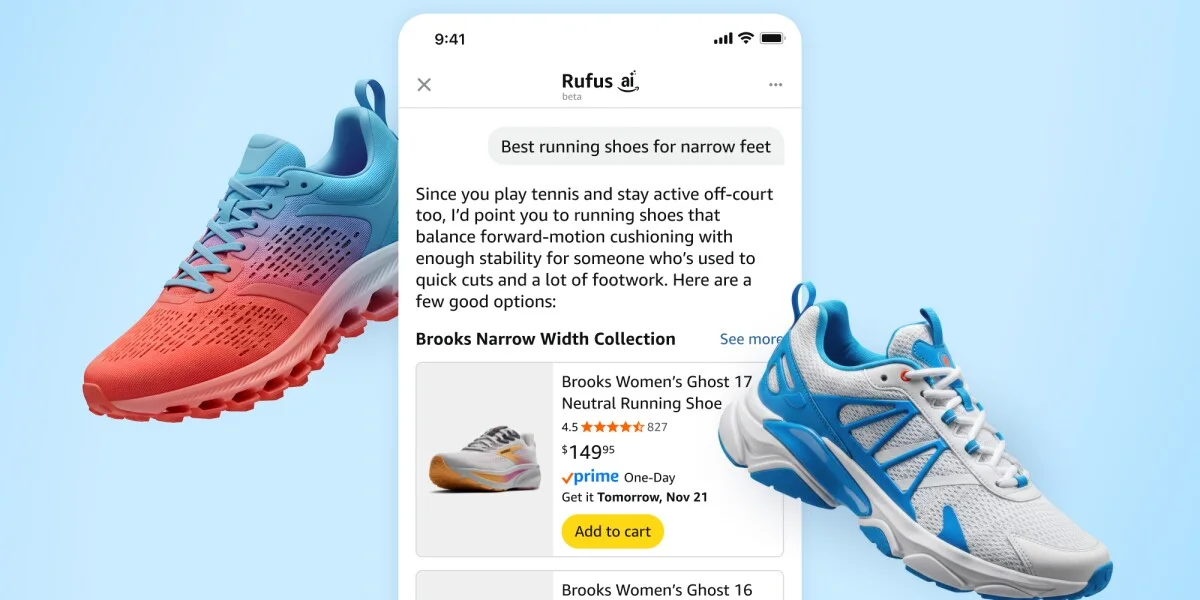
Amazon Rufus: The Full Picture of the AI Shopping Assistant Used by 250 Million People
Amazon Rufus reaches 250 million users and drives $10 billion in additional sales. Deep dive into its technology, features, and implications for e-commerce.

What is Agentic Commerce? Explaining the New Era of AI-Powered Purchasing
Explore the full scope of Agentic Commerce. AI agents autonomously execute everything from product selection to payment on behalf of users. Discover shocking data including 4,700% increase in AI-driven traffic and 20% of Walmart's traffic from ChatGPT, along with three essential preparation steps companies should start immediately.

What is Instant Checkout? Revolutionary Feature for In-Chat Purchase Completion
[2-Minute Read] Learn about Instant Checkout mechanisms and benefits. Discover how completing product discovery to purchase within AI chat reduces abandonment and boosts conversion in Agentic Commerce implementation.
Tags
Share this post