
REI's New CEO Bets on Trust Strategy in the Age of Agentic Commerce

Akihiro Suzuki
Twitter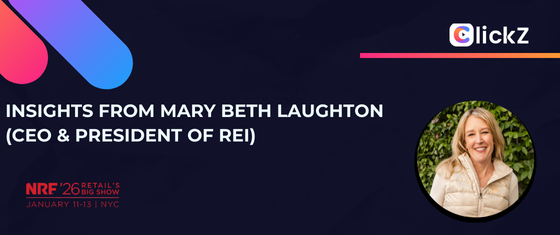
Source: www.clickz.com
Key Takeaways
- REI's new CEO Mary Beth Laughton announces a strategy centered on trust in the age of AI
- She argues that human expertise and emotional connections will remain key differentiators even as AI proliferates
- E-commerce businesses need to reassess the balance between automation and human touch
REI CEO on the Value AI Cannot Replace

REI's CEO Is Betting on Trust in an Age of Agentic Commerce

REI CEO explains how trust, green vest expertise, and mission-led strategy shape the co-op's future in an AI-driven retail world
On January 13, 2026, REI CEO Mary Beth Laughton shared her vision for retail differentiation in the age of agentic commerce. While the industry races toward AI automation, REI is charting a distinctive course centered on "trust" and "human expertise."
Speaking at NRF 2026, Laughton argued that while AI will affect every aspect of retail, technology itself will not be a differentiator. "AI has never been hiking. AI has never been camping," she said, succinctly expressing the limits of technology and the value of human "lived experience."
Background and Industry Trends
Agentic commerce is a new form of commerce where AI agents autonomously discover, compare, and purchase products on behalf of consumers. According to McKinsey's report, 10-20% of U.S. e-commerce sales (up to $385 billion) will be driven by agentic commerce by 2030.
However, challenges are emerging amid this rapid change. Currently, only 46% of consumers fully trust AI recommendations, and 89% verify information before purchasing. Even as technology evolves, earning consumer "trust" remains the biggest hurdle.
Against this backdrop, REI welcomed Mary Beth Laughton as its new CEO in January 2025. Laughton is a retail industry veteran who oversaw Nike's global D2C business and served as President and CEO of Athleta. After taking office, REI announced a three-year transformation plan called "Peak 28: Ascending Together."
REI's Trust Strategy - The Four Pillars of Peak 28
At the heart of REI's strategy is positioning. They have clearly defined themselves as "the most trusted retailer for outdoor enthusiasts" and established four pillars to achieve this.
1. Building a Connected Culture Building a high-performing, purpose-led organization where employees feel deeply connected to the business mission.
2. Authentic Assortment Delivering trend-right products that build trust and shape outdoor culture.
3. Exceptional Service Experience Building trust with customers through differentiated experiences both in-store and online.
4. Membership Refresh Providing highly differentiated services to 25 million members and deepening engagement.
Notably, "culture" is positioned as the first pillar. Laughton calls the approximately 9,000 store employees known as "Green Vests" the company's "secret weapon," emphasizing that their outdoor expertise and lived experience are REI's greatest competitive advantage in the AI era.
Implications and Applications for E-Commerce Businesses
REI's strategy offers important insights for e-commerce businesses.
Integrating Human Expertise into Digital REI incorporates product reviews and videos from store staff into their online experience, driving conversion improvements. E-commerce businesses can also leverage expert knowledge as content to create value that AI alone cannot provide.
Building Brand Around Trust VML's 2026 report proposes the concept of "Human + Tech Counterpoint." Balancing speed with trust, predictive fulfillment with surprise, and scale with care is essential.
AI as Enhancement, Not Replacement Agentic commerce does not replace human connections. By reducing friction, presenting better choices, and respecting individual preferences, retailers can become more "personal" at scale.
As REI's example shows, retailers who win in 2026 and beyond will be those who can combine the speed and precision of AI agents with the creativity, empathy, and expertise that only humans can provide.
Conclusion
REI's strategy is also a question for the entire industry. In response to "what will differentiate brands in a world where AI is ubiquitous," Laughton answered with "trust" and "human touch."
For REI, which saw 2024 sales decline 6.2% year-over-year to $3.53 billion with a net loss of $156 million, this strategic shift is also a fight for survival. However, Laughton stated, "This plan isn't about going back to our co-op past. It's about climbing the formidable mountain in front of us," demonstrating a strong commitment to transformation.
For e-commerce businesses, this movement will serve as an opportunity to reconsider automation-only strategies. In an era of coexistence with AI, we need to redefine "the value that only humans can provide." Technology may drive transactions, but relationships drive brands. REI's challenge is likely to become a touchstone for proving this principle.
References
- REI's CEO Is Betting on Trust in an Age of Agentic Commerce - ClickZ
- REI CEO Mary Beth Laughton Unveils Three-Year Transformation Strategy - Retail TouchPoints
- The agentic commerce opportunity - McKinsey
- How agentic AI will reshape shopping in 2026 - eMarketer
- Tomorrow's Commerce 2026: Human + Tech Counterpoint - VML
- Exclusive: REI's CEO shares the retailing co-op's growth strategy - Fast Company
Related Articles

What is Agentic Commerce? Explaining the New Era of AI-Powered Purchasing
Explore the full scope of Agentic Commerce. AI agents autonomously execute everything from product selection to payment on behalf of users. Discover shocking data including 4,700% increase in AI-driven traffic and 20% of Walmart's traffic from ChatGPT, along with three essential preparation steps companies should start immediately.

Experian Warns Agentic Commerce Fraud Is the Biggest Threat of 2026
Experian releases its 2026 fraud predictions. For the first time in history, AI agent fraud surpasses human error as the leading threat. E-commerce businesses must urgently build multi-layered AI-driven fraud prevention and agent authentication systems.

What is Agentic Commerce According to PwC? The Arrival of AI-Powered Purchasing and Its Business Impact
PwC defines agentic commerce as 'a new form of shopping where AI agents purchase on behalf of consumers.' GenAI-driven traffic surged 1,200% in just 6 months.
Tags
Share this post