
Forrester Analysis: Closing the Trust Gap Is Key to Agentic Commerce's Next Phase

Akihiro Suzuki
Twitter
Source: www.forrester.com
Key Takeaways
- Forrester identifies three "trust frontiers" blocking agentic commerce adoption
- Only 17-24% of consumers trust AI to complete purchases, making it the biggest bottleneck
- EC operators must immediately begin data quality improvements and incremental trust building
The "Trust Gap" Forrester Identifies
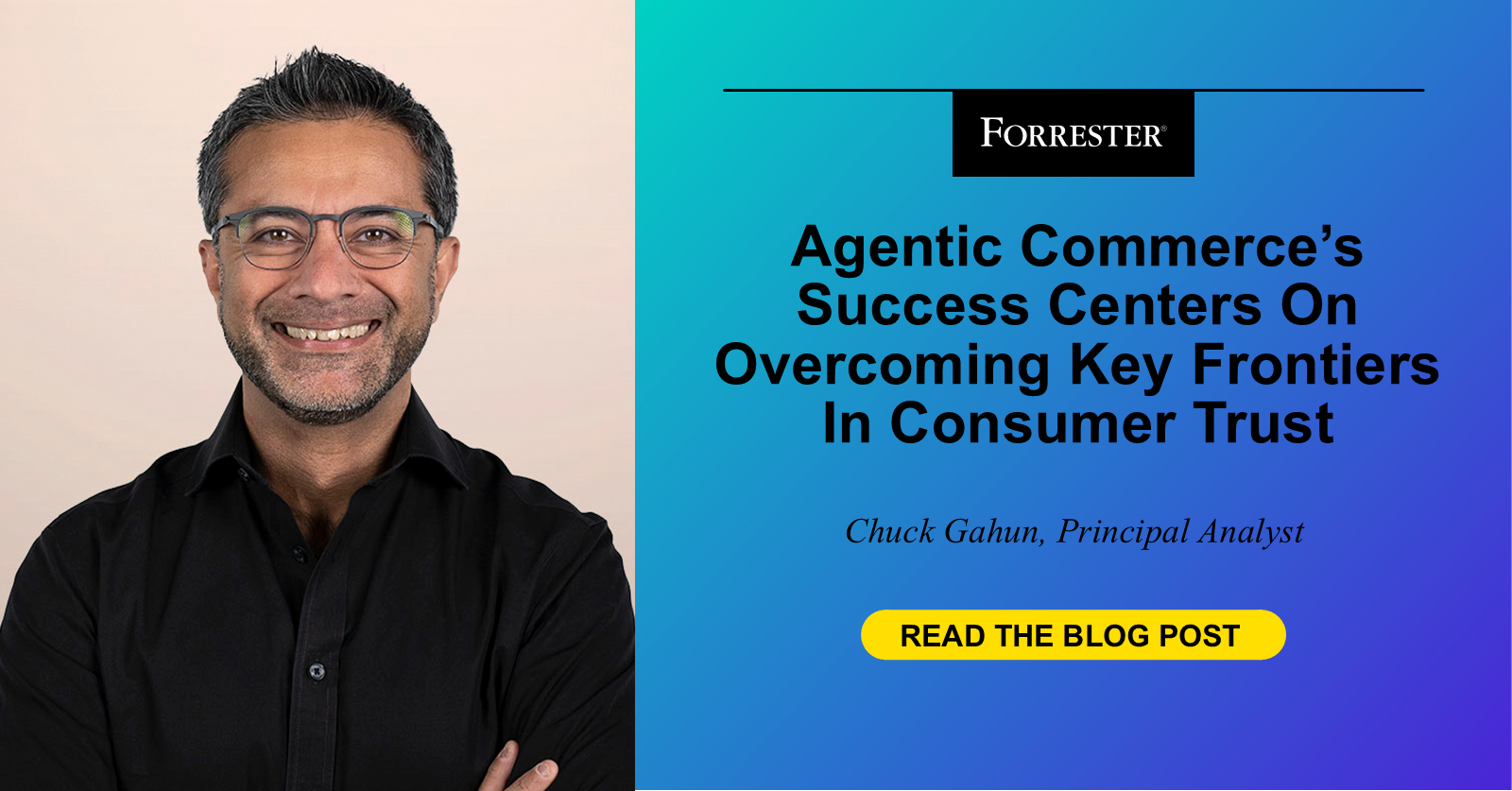
Agentic Commerce's Next Phase Hinges On Closing The Trust Gap

Forrester analysis on how the next phase of agentic commerce depends on closing the trust gap between consumers and AI-powered shopping agents.
In February 2026, Forrester published an analysis in Forbes arguing that the biggest obstacle to the next phase of agentic commerce—where AI agents search, compare, and purchase products on consumers' behalf—is the "trust gap." As Google and OpenAI compete on protocols, consumer trust has not kept pace with technological advancement.
According to Forrester's March 2025 Consumer Pulse Survey, only 24% of US online adults trust AI agents to handle routine purchases. Yet 43% acknowledge that "a future where brands market directly to AI agents is coming," revealing a disconnect between conceptual understanding and actual trust.
Industry Background and Trends
2026 is being called the "breakout year" for agentic commerce. Google announced the Universal Commerce Protocol (UCP) at the NRF conference, co-developed with Etsy, Target, and Walmart as an open standard. This is a direct counter to OpenAI's Agentic Commerce Protocol (ACP) released in October 2025.
However, even as technical foundations are established, consumer awareness lags behind. A ChannelEngine survey of 4,500 people across the US, UK, France, Germany, and the Netherlands found that while 58% have used AI tools to research products, only 17% are comfortable completing a purchase through AI. IBM-NRF's global survey similarly found that while 45% use AI in the purchasing process, only 10% have actually completed an AI-driven purchase.
Three "Trust Frontiers" and How to Overcome Them
Forrester classifies agentic commerce's trust barriers into three "frontiers."
Frontier 1: Distrust in product discovery through answer engines. AI-powered product search usage grew only marginally from 18% to 19% between February and October 2025. Due to insufficient comprehensive product data, AI remains an incomplete discovery channel, with final purchases happening elsewhere.
Frontier 2: Skepticism toward AI-mediated purchasing. Only 8% of US adults have actually used OpenAI's Instant Checkout feature. Resistance to delegating purchases to agents persists even for low-risk everyday items.
Frontier 3: Lack of standards and consumer protections. More than half of US online adults feel uneasy about sharing personal data with generative AI tools. The question of liability when an agent places an order based on incorrect product information remains unresolved.
Magebit's analysis frames the problem from an even broader perspective. Of the $34 trillion in global retail sales, approximately $28 trillion still occurs in physical stores, and this gap represents the essence of the "trust wall." The key question is whether the expertise and trust that in-store staff provide can be replicated digitally.
Impact and Implications for EC Operators
Forrester recommends that operators begin experimenting with both ACP and UCP during 2026, before sponsored content and advertising are integrated into chat responses, to secure first-mover advantage.
Specific areas operators should focus on include:
Data quality excellence. The concept Magebit calls "feed integrity" is critical. Price discrepancies or "ghost inventory" (products displayed as available when they are not) cause AI agents to deprioritize a store. Structured, accurate product data is the first step to earning agent trust.
Reviews and social proof accumulation. AI agents perform sentiment analysis across thousands of reviews to inform recommendations. ChannelEngine's survey also found that 3 in 5 consumers hesitate to purchase products without reviews.
Incremental trust building by design. 48% of consumers cite "the ability to confirm and approve before AI takes action" as a condition for trust. Designs that maintain human confirmation steps in the purchase process while gradually expanding the scope of AI delegation are essential.
Summary
As Forrester's analysis demonstrates, the challenge for agentic commerce is no longer technology but "trust." Platform-side activity is accelerating with Google and OpenAI's protocol competition and Amazon's potential entry. But without consumer trust, this market will not take off.
Forrester concludes that "the winners won't be those who invest the most, but those who align technology with measurable economic value, robust governance, and trusted human expertise." For EC operators, 2026 is the most critical time to begin building trust foundations.
Related Articles

75% of Retailers Unprepared for Agentic Shopping - Patchworks Survey Reveals Technology Stack Challenges
Only 27% of UK retailers have technology infrastructure capable of supporting agentic shopping. 60% experience annual revenue losses due to poor system integration, with 10% losing over £1 million annually.
REI's New CEO Bets on Trust Strategy in the Age of Agentic Commerce
REI's new CEO Mary Beth Laughton announces a strategy centered on trust and human expertise in the age of agentic commerce. She argues that human expertise and emotional connections will remain key differentiators even as AI proliferates. E-commerce businesses need to reassess the balance between automation and human touch.

What is Instant Checkout? Revolutionary Feature for In-Chat Purchase Completion
[2-Minute Read] Learn about Instant Checkout mechanisms and benefits. Discover how completing product discovery to purchase within AI chat reduces abandonment and boosts conversion in Agentic Commerce implementation.
Tags
Share this post