
EC & AI Commerce News Digest (January 13, 2026)

Akihiro Suzuki
Twitter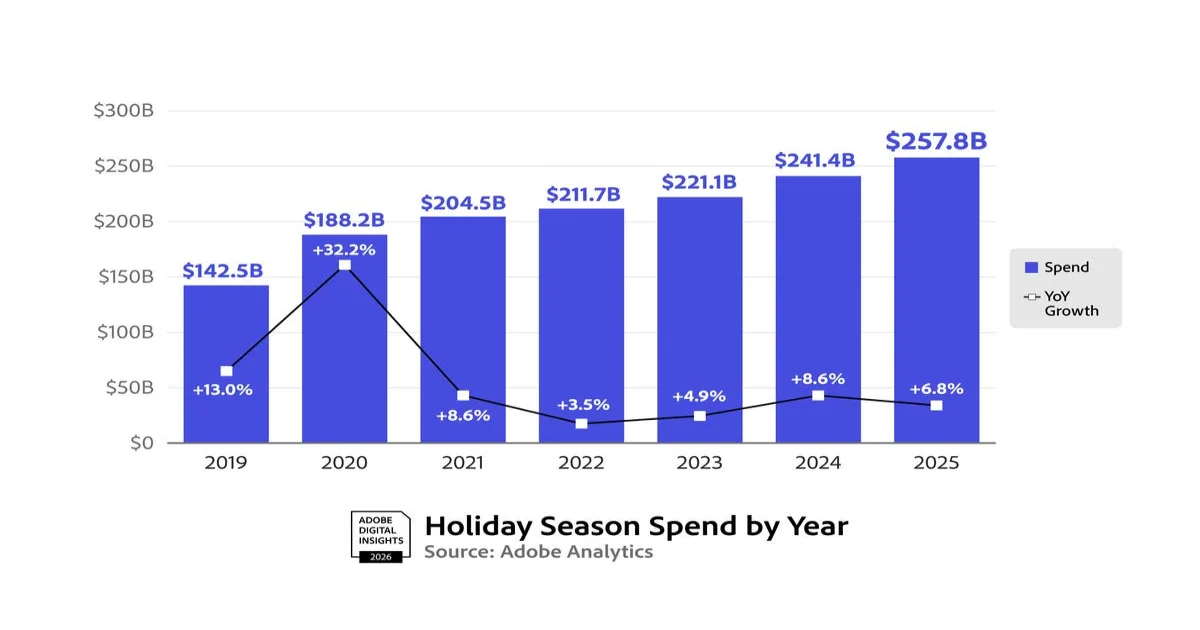
Source: news.adobe.com
Key Takeaways
- Adobe Report: 2025 Holiday Season saw 693% YoY increase in AI-driven e-commerce traffic
- PayPal powers Microsoft Copilot Checkout, expanding agentic payment infrastructure
- SSENSE founders win buyback bid, case highlights impact of de minimis rule elimination
In the second week of January 2026, a wave of agentic commerce announcements has emerged following the NRF (National Retail Federation) conference. Today's digest brings you 6 news stories useful for e-commerce operators, including Adobe's research showing explosive AI traffic growth, PayPal's payment infrastructure expansion, EU e-commerce regulations, and Walmart's international expansion.
Note: For Google UCP, Shopify Agentic Storefronts, and commercetools/JD Sports, please refer to yesterday's articles.
Today's Top News
Adobe Report: AI-Driven Traffic Up 693% in 2025 Holiday Season
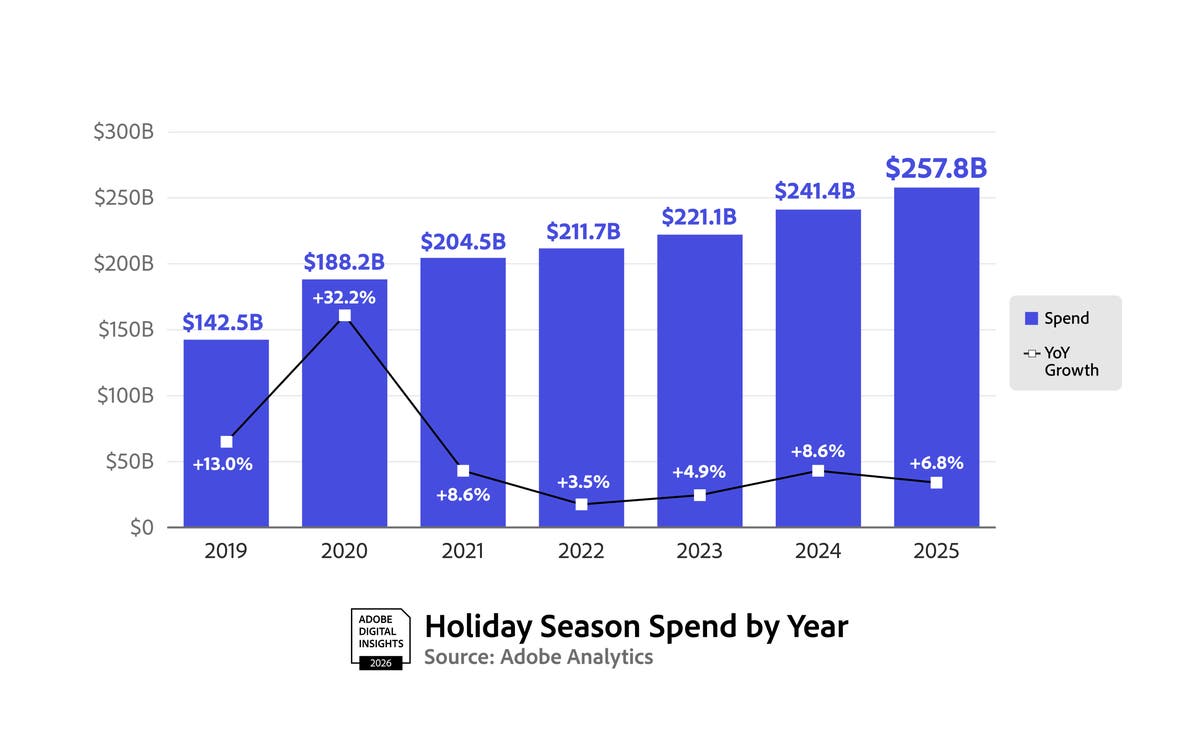
Adobe: Holiday Shopping Season Drove a Record $257.8 Billion Online

Adobe released online shopping data for the 2025 holiday season, covering the period from Nov. 1 through Dec. 31, 2025 where consumers spent $257.8 billion online up 6.8% year-over-year.
According to Adobe's 2025 holiday season (November 1 - December 31) e-commerce analysis report, traffic from generative AI tools to retail sites increased 693.4% year-over-year.
Online sales reached a record $257.8 billion, up 6.8% from the previous year's $241.4 billion. The number of days with sales exceeding $4 billion reached 25, a significant increase from 18 days in 2024.
Notably, AI-driven traffic showed 31% higher conversion rates compared to other traffic sources, roughly doubling from the previous year. On Cyber Monday, AI-driven traffic increased 670%, demonstrating that AI is becoming established as a tool for product research and deal discovery.
PayPal Powers Microsoft Copilot Checkout, Full-Scale Agentic Payments Launch

PayPal Powers Microsoft's Launch of Copilot Checkout
Copilot Checkout delivers seamless, trusted purchases powered by PayPal
On January 8, PayPal announced a partnership with Microsoft to provide the payment infrastructure for Copilot Checkout. Consumers can seamlessly purchase from product discovery to payment completion within Copilot, without redirects.
PayPal is deploying an "Agent Ready" payment solution that allows millions of existing PayPal merchants to accept AI-driven payments without additional technical implementation. Fraud detection, buyer protection, and dispute resolution all use existing systems.
Furthermore, PayPal has partnered with OpenAI (ChatGPT), Perplexity, and Google (Agent Payments Protocol), establishing a cross-platform position handling payments across multiple AI platforms.
Global E-Commerce Trends
Why EU E-commerce Rules Seem Complex: A Guide for Practitioners

Why E.U. Ecommerce Rules Seem Complex
A regulatory overview for e-commerce operators considering EU market entry
Practical Ecommerce explains the complexity of regulations faced when doing business in the EU market.
The EU lacks a single regulatory framework, with multiple overlapping regulations including GDPR, Digital Services Act (DSA), Omnibus Directive, geo-blocking regulations, and General Product Safety Regulation. Some apply uniformly across the EU, while others require implementation in each country, creating compliance challenges that are "theoretically centralized, practically fragmented."
Large enterprises can absorb costs, but SMEs face heavy resource burdens for review transparency and price display requirements. However, the article notes that in the consumer-protection-focused EU market, early compliance investment can build brand trust.
Walmart International Posts 10.8% Sales Increase Led by Mexico

Walmart Posts 10.8% Jump in International Sales
Walmart International performs strongly, driven by Mexico, China, and India
Walmart announced Q3 FY2026 international sales of $33.5 billion, up 10.8% year-over-year, driven by growth in Mexico, China, and India.
Notable is each region's digital strategy. Walmart Mexico (Walmex) is pushing promotions like "El Fin Irresistible" and digital enhancement. Sam's Club China's digital channels now account for about 50% of total revenue, with sales up 21.8%. India's Flipkart processed 87 orders per second during its "Big Billion Days" sale.
Walmart states it has "integrated AI into more than 40% of software applications" and is expanding automated distribution centers internationally.
Corporate News & Partnerships
SSENSE Founders Win Buyback Bid, Case Highlights De Minimis Impact

SSENSE Founders Win Bid to Maintain Control
SSENSE Founders Win Bid to Maintain Control: Stability restored.
The three founding brothers of Montreal-based luxury fashion e-commerce platform SSENSE have been confirmed to maintain control through a court-supervised restructuring process. Closing is expected by February 13.
SSENSE received a $5 billion valuation in 2021 but saw declining sales from 2023 to 2025, filing for creditor protection in September 2025. One factor the company cited for financial deterioration was "the elimination of the US de minimis exemption." Previously, products under $800 could be imported into the US without duties or taxes, but this policy change significantly increased US shipping costs. US sales from September to December 2025 dropped more than 60% year-over-year.
This case serves as a warning about the impact of trade policy changes on cross-border e-commerce.
Market Analysis
McKinsey: AI Retail Market Could Reach $3-5 Trillion by 2030

Agentic commerce: How agents are ushering in a new era
Discover how agentic commerce uses AI shopping agents to transform retail with hyperpersonalized experiences, autonomous transactions, and innovation.
McKinsey's latest report estimates the economic impact of agentic commerce on the retail industry, suggesting it could reach $3-5 trillion globally by 2030.
McKinsey describes agentic commerce as a "tectonic shift," defining it as a model where AI agents search for products, negotiate, and execute transactions on behalf of humans. Shopping will transform from discrete steps of "search → browse → compare → purchase" to an "intent-driven continuous flow" by autonomous AI systems.
Regarding transition speed, McKinsey suggests this could progress faster than previous platform shifts. AI systems can leverage existing digital infrastructure, eliminating the need to wait for new foundations.
Summary
Today's digest confirmed both pillars of the agentic commerce era: explosive AI traffic growth (Adobe report) and the payment infrastructure supporting it (PayPal).
For e-commerce operators, the practical points to watch are EU regulation compliance and the de minimis elimination impact. The SSENSE case concretely demonstrates trade policy risks in cross-border e-commerce. Meanwhile, Walmart's international expansion serves as a good example of how digital and AI investment drives growth.
Key points to watch going forward include detailed implementations announced at NRF 2026 and the UCP technical specification release.
Reference Links
- Adobe Holiday Shopping Report - Adobe
- PayPal Powers Microsoft's Launch of Copilot Checkout - PayPal
- Why E.U. Ecommerce Rules Seem Complex - Practical Ecommerce
- Walmart International Sales - Mexico Business News
- SSENSE Founders Win Bid - Hypebeast
- McKinsey Agentic Commerce Report - McKinsey
Related Articles

What is Agentic Commerce? Explaining the New Era of AI-Powered Purchasing
Explore the full scope of Agentic Commerce. AI agents autonomously execute everything from product selection to payment on behalf of users. Discover shocking data including 4,700% increase in AI-driven traffic and 20% of Walmart's traffic from ChatGPT, along with three essential preparation steps companies should start immediately.

Microsoft Announces Copilot Checkout at NRF 2026, Enabling In-AI Purchases with Stripe, PayPal, and Shopify
Microsoft announces Copilot Checkout at NRF 2026, enabling purchases within AI conversations. Shopify merchants auto-enrolled. E-commerce businesses need early preparation for this new sales channel.
Salesforce Unveils Major Agentforce Commerce Updates with Two-Way AI Communication at NRF 2026
Salesforce announces new Agentforce Commerce features at NRF 2026, enabling two-way AI conversations via SMS, WhatsApp, and email. Companies using AI agents achieved 59% higher growth rates.
Tags
Share this post